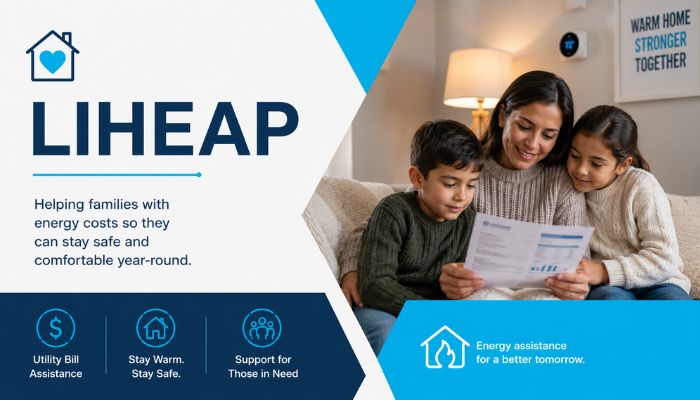
Managing unpredictable utility bills during extreme weather seasons can place an immense financial strain on household budgets. For low-income families, elderly individuals, and vulnerable households, the rising cost of heating and cooling is more than an inconvenience—it is a critical safety issue. Fortunately, the Low Income Home Energy Assistance Program (LIHEAP) serves as America’s premier federal safety net, helping eligible households maintain safe, healthy indoor temperatures.
Find out about: Medicare
If you are looking to lower your electric bill, secure emergency utility crisis funding, or discover how to access government assistance for home weatherization, this definitive guide covers everything you need to know about maximizing your LIHEAP benefits today.
What is LIHEAP and How Does Energy Assistance Work?
The Low Income Home Energy Assistance Program (LIHEAP) is a federally funded program established in 1981 and administered by the U.S. Department of Health and Human Services (HHS). While the federal government provides the funding, the program is operated at the state, tribal, and territorial levels by local social service agencies and community action partnerships.
The Core Objectives of the Program
LIHEAP is structurally engineered to assist low-income households in meeting their immediate home energy needs. Rather than acting as a permanent welfare program, it focuses on short-term, high-impact intervention through three main financial avenues:
-
Heating Assistance: Direct financial support to help cover utility bills during freezing winter months.
-
Cooling Assistance: Financial aid to offset expensive electricity bills driven by air conditioning usage during summer heatwaves.
-
Energy Crisis Intervention: Emergency funding designed to resolve immediate, life-threatening energy crises, such as utility shut-offs or broken HVAC equipment.
How LIHEAP Benefits Are Paid
In the vast majority of cases, LIHEAP does not send cash payments directly to the applicant. Instead, the local agency issues a direct payment or utility bill credit to your energy provider (e.g., your electric or natural gas company), which is then applied directly to your account balance to lower or eliminate your outstanding debt.
Navigating LIHEAP Eligibility Requirements and Income Limits
Because LIHEAP operates on a capped federal block grant, funds are limited, and meeting the baseline criteria is essential for securing your share of government financial help.
Federal and State Income Benchmarks
To qualify for LIHEAP, a household’s total gross income cannot exceed specific regulatory thresholds. By federal law, states must cap eligibility at or below either:
-
150% of the Federal Poverty Level (FPL), or
-
60% of the State Median Income (SMI).
States have the flexibility to lower these income limits down to 110% of the FPL, making it vital to check your specific local jurisdiction’s guidelines for the current fiscal year.
Priority Categories for Fast Track Approval
Due to high demand and limited funding, local agencies utilize a priority points system. Applications are processed faster, and higher benefit amounts are awarded to households containing highly vulnerable individuals, including:
-
Seniors: Adults aged 60 or older.
-
Individuals with Disabilities: Family members receiving disability benefits or experiencing severe health limitations.
-
Young Children: Households with children under the age of five.
Beyond Bill Pay: Harnessing the Power of Weatherization Assistance
One of the most underutilized yet lucrative aspects of the LIHEAP framework is its integration with home energy efficiency programs.
The LIHEAP Weatherization Sub-Grant
Federal guidelines allow states to allocate up to 15% (and sometimes 25% with a waiver) of their total LIHEAP funding toward residential weatherization assistance. This program helps low-income homeowners and renters permanently reduce their energy consumption—and their future bills—by making structural improvements to the home at zero cost to the resident.
Free Energy Efficiency Upgrades Included
If your home qualifies for LIHEAP weatherization services, a certified energy auditor will inspect your residence and arrange for professional contractors to perform upgrades, such as:
-
Insulating attics, walls, crawlspaces, and exposed pipes.
-
Sealing air leaks around windows, doors, and foundations using weatherstripping and caulk.
-
Repairing, tuning, or completely replacing inefficient or dangerous heating and cooling systems (HVAC).
-
Installing energy-efficient LED lighting and programmable smart thermostats.
Step-by-Step Guide: How to Apply for LIHEAP Online
The application window for LIHEAP varies significantly by state, with many states opening winter applications in October or November and summer applications in April or May.
The Online Application and Intake Process
-
Locate Your Local LIHEAP Office: Visit the official HHS web portal or use the national National Energy Assistance Referral (NEAR) hotline to identify your local administering agency.
-
Gather Comprehensive Verification Documents: You will need to provide digital or physical copies of your recent utility bills, proof of address (lease or mortgage statement), government IDs for all household members, and proof of gross income (pay stubs, tax returns, or benefit award letters).
-
Submit via State Portal: Complete the digital intake form via your state’s health and human services portal.
-
Automatic Income Qualifications: If your household already receives benefits from SNAP (food stamps), SSI (Supplemental Security Income), or TANF, your state may automatically fast-track your income-eligibility screening.
The Broader Impact of Energy Security
«Public health data shows that robust LIHEAP implementation directly correlates with a decrease in eviction rates, a reduction in seasonal illness for elderly citizens, and fewer emergency room visits related to extreme temperature exposure.»
LIHEAP provides more than financial relief—it delivers peace of mind and physical safety. By eliminating the impossible choice between heating a home and buying life-saving medication or groceries, this program stands as a pillar of community stability.
Taking control of your household’s financial health requires leveraging every available public resource. Explore your state’s current open enrollment windows, gather your documentation, and apply for LIHEAP today to protect your family and permanently lower your energy expenses.